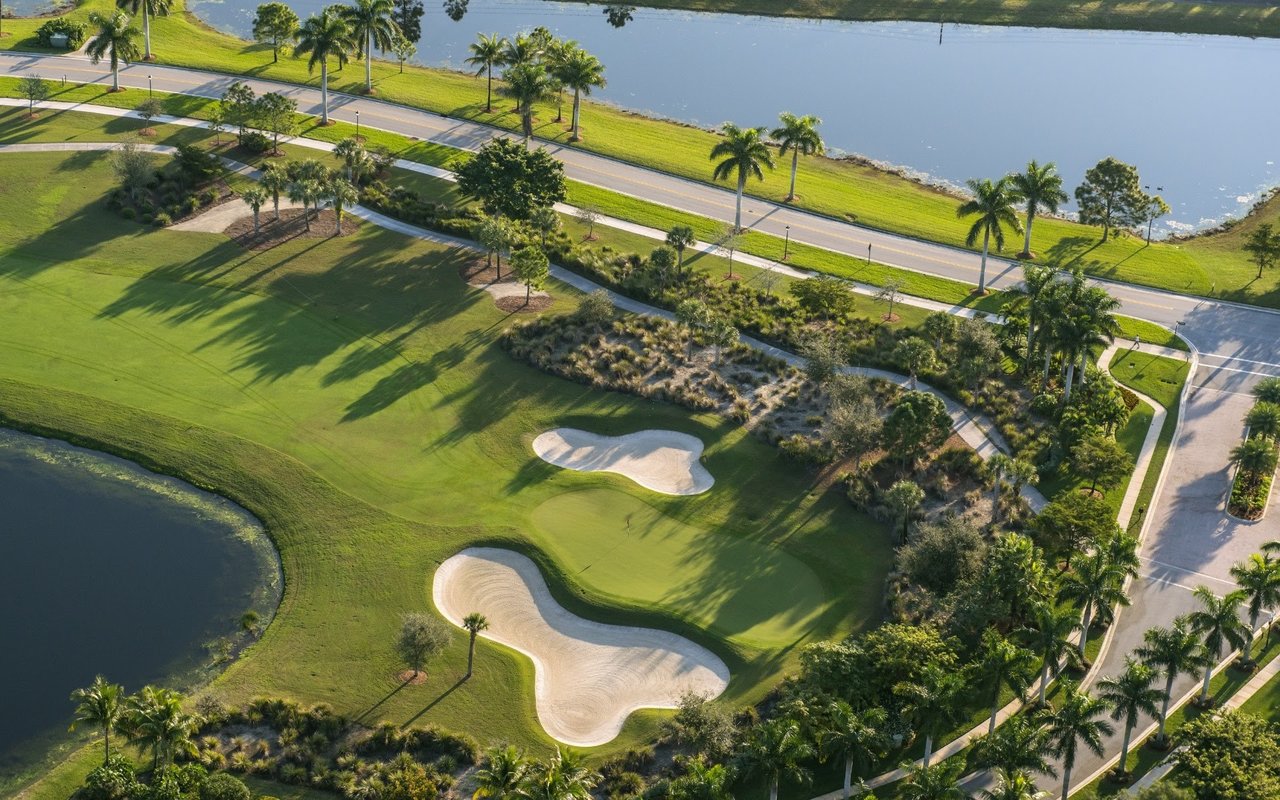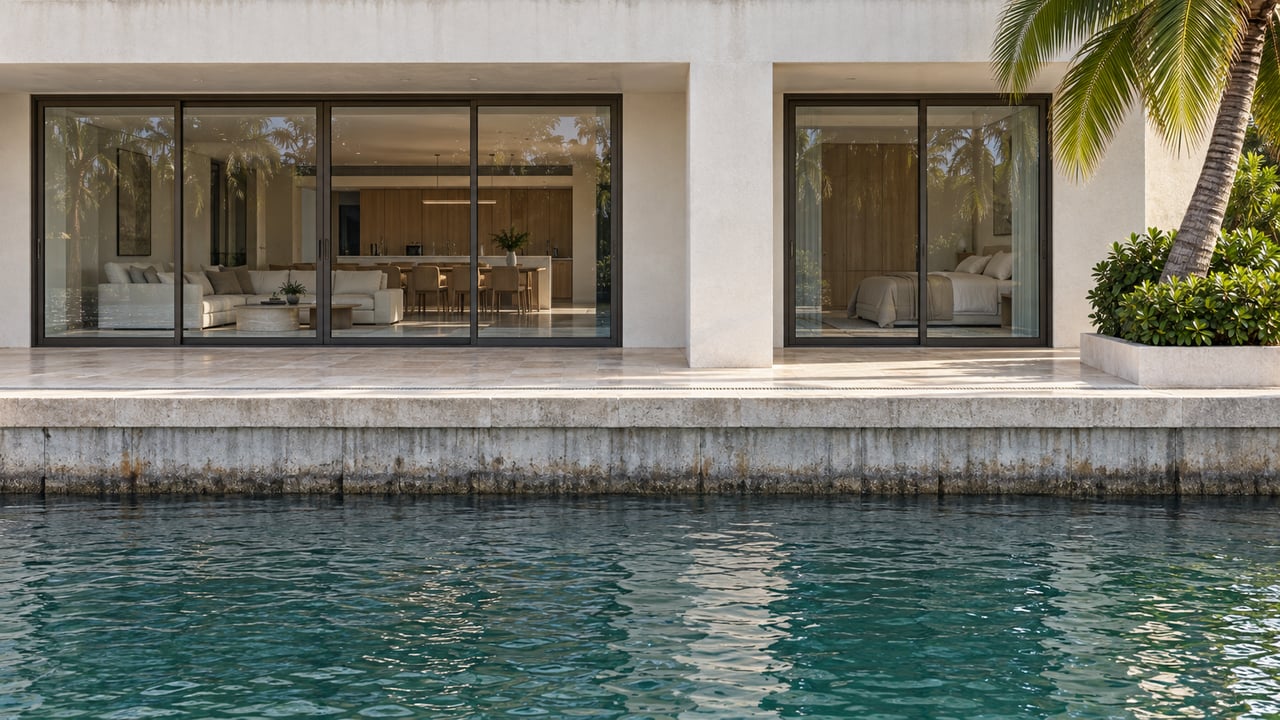
Two houses sit on the same type of canal in Fort Lauderdale. Same three bedrooms, same pool, same recent kitchen renovation, same walk to Las Olas Boulevard. One sells within weeks at a price that makes the listing agent's phone ring for a month. The other sits for the better part of a year and eventually closes tens of percent lower. Nothing about the structures explains the gap. What explains it is a piece of infrastructure neither owner built and neither owner can change: whether a fixed bridge stands between that dock and the open ocean.
Most fixed bridges in Fort Lauderdale offer somewhere between 14 and 17 feet of vertical clearance at mean high water. A center console clears that without thinking about it. A sportfisher with an enclosed flybridge and outriggers, or a sailboat carrying a tall mast, does not. For a buyer shopping with a real boat in mind, that clearance number is not a footnote on the listing. It is the filter that decides which homes are even candidates.
Same Street, Two Different Markets
The clearest version of this split in Fort Lauderdale runs down a single road. On Bayview Drive, in the Landings, the east side has no fixed bridges at all, with wide canals and lots that average roughly 90 feet of linear waterfront. The west side of the same street sits behind two fixed bridges holding about 10 and a half feet of clearance at high tide. Bay Colony, nearby, also carries no fixed bridges and some of the widest, deepest protected canals in the city.
Walk a few blocks in the other direction and you cross into Lake Estates and Golf Estates, both behind that same 10-and-a-half-foot restriction, with one bridge at NE 59th Street dropping to roughly 5 feet of clearance at high tide on the north side. Same neighborhood identity, same general commute to downtown, same architecture era in many cases. Different water underneath.
This is not a Fort Lauderdale quirk that shows up only in one corner of the city. Rio Vista, Las Olas Isles, Harbor Beach, Coral Ridge waterfront blocks, and Seven Isles all draw their premium status from unrestricted ocean access, close enough to Port Everglades that a captain never has to check a clearance chart. Homes in Middle River corridors and parts of Victoria Park carry a different profile because a fixed bridge stands between them and the Intracoastal.
What the Bridge Is Actually Pricing
A functional private dock in Fort Lauderdale typically adds something in the range of 5 to 15 percent to a waterfront home's value compared with a similar property that has only a seawall. Deep-water docks built to hold yachts of 50 feet or more, sitting behind no-fixed-bridge access, can add 15 to 25 percent or more on top of that, because the pool of buyers who actually need that access is smaller, wealthier, and willing to pay for certainty rather than negotiate around a bridge schedule.
Not every bridge blocks access the same way. Fixed bridges do not open, full stop. Movable bridges, like the SE 17th Street Causeway spanning the New River, are a different animal entirely. That span closes to about 55 feet of vertical clearance at mean high water but opens on a published schedule, commonly on the hour and half hour, with bridge tenders monitoring VHF channel 9. A boat with a tall mast can still get out to the ocean through a movable bridge. It just has to plan around the schedule. A fixed bridge offers no such option. That distinction, fixed versus movable, matters more to a buyer's search criteria than the number of bridges crossed.
The Slow Market That Isn't Actually Slow
Homes in Rio Vista have taken an average of around 107 days to sell, well above national medians. On a surface read, that looks like weak demand for one of the city's most recognized waterfront names. It is closer to the opposite. No-fixed-bridge, deep-water properties draw a narrower, more particular buyer pool, people who are matching a specific vessel to a specific dock and canal width before they will write an offer. That narrower pool takes longer to clear, even when the eventual sale price reflects real strength.
The pricing data for Rio Vista also illustrates a separate trap for anyone comparing neighborhood medians across listing sites. One tracking service put the trailing twelve month median sale price in Rio Vista at $2.3 million as of February 2026, itself down 18 percent from the prior twelve month window. A different site's single-month snapshot for the same pocket of streets showed something close to $950,000, an apparent swing that has nothing to do with a sudden collapse in value and everything to do with how few ultra-luxury homes trade in any given month. When only a handful of sales close in a 30-day window, one distressed sale or one modest renovation can swing a reported median by double digits without changing what the market actually thinks a comparable, no-fixed-bridge Rio Vista estate is worth. Anyone comparing a single month's figure across two portals for a micro-market this thin should treat the number as noise until it is checked against a longer trailing window.
The Bridge That's Being Rebuilt Right Now
There is a live example of infrastructure directly shaping this equation as of this fall. The Florida Department of Transportation has an active rehabilitation project on the Sunrise Boulevard bridge over the Middle River, with a virtual public meeting held in May 2026 covering the scope of work. The current phase replaces the bridge deck with a solid surface aluminum deck, repaints the structural steel, replaces mechanical and electrical components and the marine fenders in the waterway, renovates the bridge tender house, and resurfaces the roadway.
An earlier phase of work on this same crossing was designed to raise vertical clearance by roughly four feet. Whether the current 2026 phase carries that clearance increase forward is not something the public meeting materials settle outright, but the project itself is the kind of detail worth tracking for anyone evaluating a property along Middle River Drive or in the Sunrise Intracoastal area. A bridge rehabilitation that touches marine fenders and mechanical systems can also mean temporary closures or altered opening patterns during construction, which is worth a direct question to the seller's agent before scheduling a boat-in showing.
Before You Write the Offer
A short list of items worth confirming on any Fort Lauderdale waterfront property before an offer goes in, regardless of neighborhood name:
- The exact vertical clearance of any bridge between the dock and open water, measured at mean high water, not the number posted from memory
- Whether that bridge is fixed or movable, and if movable, its published opening schedule
- Water depth at low tide at the actual dock, compared against your vessel's draft plus a safety margin, verified with a recent survey rather than the listing description
- Whether an existing dock is fully permitted. Fort Lauderdale properties without a permitted dock require building one from scratch, a process that typically runs 3 to 6 months and costs $30,000 to $150,000 or more depending on length and materials
- Seawall condition, ideally checked by a licensed marine contractor. Seawall repairs run roughly $150 to $500 per linear foot, so a failing 80-foot wall can represent a $40,000 to $80,000 cost before the dock is even usable
- The city's limit on how far a boat or mooring structure can project into the canal, capped at 30 percent of the canal's width as measured from the recorded property line, which affects what size vessel a given dock can practically hold regardless of what fits on paper
None of these show up cleanly in a listing photo. All of them move the price.
FAQ
Does "ocean access" always mean no fixed bridges? No. A property can be marketed with ocean access while the actual route still passes under one or more fixed bridges with limited clearance. The two terms get used loosely enough that confirming the specific route, not just the phrase in the listing, is worth the extra step.
Can a fixed bridge ever be changed to raise a home's value? Not by the homeowner. Bridge type and clearance are set by whichever public agency owns the crossing, and any change comes through a public infrastructure project, not a private renovation. That permanence is exactly why the feature carries the premium it does. A kitchen can be redone. A bridge cannot.
Why do median price figures for the same Fort Lauderdale neighborhood vary so much between sources? In the ultra-luxury, low-inventory segment of neighborhoods like Rio Vista, a handful of closings in any given month can swing a reported median substantially. A trailing twelve month figure tends to be more stable than any single month's snapshot, and it is worth asking an agent to walk through both before treating either number as settled.
If a Fort Lauderdale waterfront property is on your list and a specific boat is part of the plan, the bridge clearance and dock depth deserve the same early scrutiny as the floor plan. Stephanie Muzzillo and The Luxury Palms Group can pull the bridge, canal width, and dockage details on a specific address before you schedule a tour.